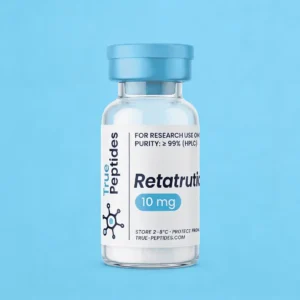
Tesamorelin Research Peptide – Essential Research and Safety Guide
Introduction to Tesamorelin Research Peptide
Tesamorelin is a synthetic peptide that has attracted scientific attention because of its relationship with growth hormone regulation. It is a synthetic analogue of growth hormone-releasing hormone (GHRH), a naturally occurring hormone involved in signalling the pituitary gland to release growth hormone.
Research into tesamorelin has focused on endocrine signalling, metabolic processes, and specific clinical applications. Understanding its biological background, clinical evidence, and safety considerations is important when evaluating information about this peptide.
The term “Tesamorelin Research Peptide” may appear in research and commercial product descriptions. However, a product label alone does not establish the identity, quality, regulatory status, or suitability of a particular material.
What Is Tesamorelin?
Tesamorelin Research Peptide is designed to mimic the activity of GHRH. Under normal physiological conditions, GHRH is produced in the hypothalamus and signals the pituitary gland to release growth hormone. Growth hormone subsequently influences several biological processes, including the regulation of metabolism and the production of insulin-like growth factor 1 (IGF-1).
Because tesamorelin acts through this signalling pathway, it has been investigated in clinical settings where modifying growth hormone activity may have a specific therapeutic purpose.
Its effects depend on complex interactions within the endocrine system. They should not be interpreted as evidence that the peptide is suitable for general performance enhancement, anti-ageing purposes, or unsupervised weight management.
Scientific Research and Growth Hormone Signalling
Tesamorelin Research Peptide contributes to scientific understanding of the relationship between GHRH signalling, growth hormone secretion, and metabolic regulation.
Researchers have examined its effects on visceral adipose tissue, which is fat stored around internal abdominal organs. Clinical studies in particular patient populations have investigated whether tesamorelin can reduce excess visceral abdominal fat.
These findings are specific to the populations and medical circumstances studied. They do not establish equivalent outcomes for healthy individuals or people seeking general weight loss.
Research involving hormone signalling also requires careful attention to individual differences, baseline health, treatment duration, and potential effects on other hormonal pathways.
Clinical Applications and Evidence
In the United States, tesamorelin is an approved prescription medicine for reducing excess abdominal fat in adults with HIV-associated lipodystrophy. This is a specific medical indication and should not be confused with a general indication for obesity or routine weight management.
The evidence supporting an approved medical use does not mean that every product marketed under the tesamorelin name has been evaluated or authorised. The formulation, manufacturing quality, approved indication, and regulatory status all matter when assessing a product.
Clinical findings should be interpreted using reliable medical information and the approved prescribing documentation applicable to the relevant country.
Understanding Product Identification and Documentation
When reviewing information about a product labelled as tesamorelin, the stated name or quantity is only one part of the assessment. Labelling cannot independently verify composition, purity, sterility, or clinical suitability. Tesamorelin Research Peptide Tesamorelin Research Peptide Tesamorelin Research Peptide Tesamorelin Research Peptide Tesamorelin Research Peptide
Relevant documentation may include:
- Product identification: Clear information identifying the stated substance and formulation.
- Batch traceability: Records linking a product to its manufacturing batch.
- Analytical documentation: Appropriate testing records, interpreted within their stated limitations.
- Packaging integrity: Legible labelling and packaging without obvious damage.
- Regulatory information: Evidence that the product is authorised for its stated purpose in the relevant jurisdiction.
These checks can support informed evaluation but do not replace regulatory review or professional medical assessment.
Safety and Potential Risks
Tesamorelin affects a hormone pathway with consequences beyond a single metabolic process. Its use can therefore require medical supervision and appropriate monitoring.
Potential safety concerns include increased IGF-1 levels, fluid retention, joint or muscle discomfort, and changes in glucose regulation. Hypersensitivity reactions and other adverse effects may also occur. The specific risks depend on the individual and the product being used.
Tesamorelin may be unsuitable for certain people, including those with active malignancy or specific conditions affecting the pituitary gland. Pregnancy and other medical circumstances may also affect whether its use is appropriate.
These concerns are among the reasons tesamorelin should not be treated as an ordinary wellness supplement. People who have questions about its potential medical use should speak with a qualified healthcare professional and consult the official prescribing information.
Regulatory and Research Considerations
Regulatory authorisation applies to specific products, formulations, indications, and jurisdictions. A research designation does not mean that a substance has been approved for human administration.
Products sold through unregulated channels may not have the same manufacturing controls, verified composition, or clinical oversight as authorised prescription medicines. Online descriptions and preliminary research cannot establish that a particular product is safe or effective.
Research materials should be handled according to applicable institutional procedures and regulatory requirements. They are not intended for human or veterinary consumption unless the specific product has the necessary authorisation for that use.
Responsible Interpretation of Scientific Information
Evaluating tesamorelin requires distinguishing clinical evidence from marketing claims. Published studies should be considered in light of their design, participants, measured outcomes, limitations, and independent confirmation.
A demonstrated effect in one clinical population does not automatically establish a benefit for another population or a different purpose. Likewise, the existence of an approved prescription formulation does not validate every product sold under the same compound name.
Reliable medical sources and current regulatory documentation provide a stronger foundation for understanding tesamorelin than unsupported online claims.
Conclusion
Tesamorelin is a synthetic GHRH analogue studied for its effects on growth hormone signalling and metabolic processes. It has a specific approved prescription use in the United States for reducing excess abdominal fat in adults with HIV-associated lipodystrophy.
Its hormonal activity, potential adverse effects, and regulatory requirements make accurate information particularly important. Reviewing the clinical evidence, verifying product documentation, and understanding the limits of approved indications help distinguish established medical uses from unverified claims about research peptides.