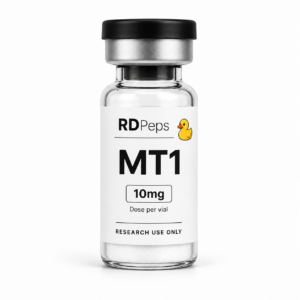
MT1 10mg Vial – Scientific Background, Research and Safety Guide
Understanding MT1 10mg Vial (Melanotan I)
MT1 10mg Vial, commonly known as Melanotan I, is a synthetic peptide associated with research into melanocortin receptors and the biological processes involved in skin pigmentation. It is related to alpha-melanocyte-stimulating hormone (α-MSH), a naturally occurring peptide involved in several physiological functions.
The term MT1 10mg Vial is a product-label description indicating a stated quantity of 10 milligrams. However, a label alone does not confirm a product’s identity, purity, concentration, sterility, or suitability for a particular application.
Understanding Melanotan I requires distinguishing scientific research from unverified claims made about products sold online. Its biological activity and potential risks should be considered using reliable scientific and regulatory information.
What Is Melanotan I?
Melanotan I is a synthetic peptide developed to investigate melanocortin pathways involved in pigmentation. These pathways are part of a broader biological system that influences skin pigmentation and other physiological functions.
Melanocortin receptors are found in different tissues and participate in a variety of biological processes. Research into these receptors has contributed to a better understanding of pigmentation, hormonal signalling, and related mechanisms.
Melanotan I is distinct from other compounds sometimes marketed under similar names. For example, Melanotan II has a different structure and pharmacological profile. The two should not be treated as interchangeable, and information about one compound may not apply directly to the other.
How Melanocortin Receptors Relate to Skin Pigmentation
Skin pigmentation is influenced by melanin, a natural pigment produced by specialised cells called melanocytes. Melanin contributes to skin, hair, and eye colour and plays a role in protecting skin cells against some effects of ultraviolet radiation.
Melanocortin signalling is one of the biological systems involved in regulating melanin production. The melanocortin-1 receptor, commonly abbreviated as MC1R, has an important role in this process.
Activation of this receptor can influence the activity of melanocytes and the type and amount of melanin produced. Genetic differences, hormonal signalling, ultraviolet exposure, and other biological factors can influence pigmentation.
Although these mechanisms are well established areas of scientific study, they do not mean that unlicensed products marketed for tanning are safe or provide reliable protection from sunlight.
Scientific Research and Investigational Context
Research into melanocortin peptides has examined their interactions with receptors and their possible biological applications. This work has helped scientists understand the relationship between receptor signalling and pigmentation.
However, evidence about a peptide’s biological activity does not automatically demonstrate that every formulation containing it is safe, effective, or suitable for use in humans.
Research findings must be assessed according to study design, the compound examined, the population studied, and the outcomes measured. Laboratory experiments, animal studies, and human clinical trials provide different kinds of evidence and should not be treated as equivalent.
It is also important to distinguish Melanotan I from afamelanotide, a related but distinct substance used in an authorised medicine for a specific medical indication in certain jurisdictions. Approval of one medicine does not establish the safety or authorization of other products marketed under similar names.
Understanding the 10mg Vial Label
A label stating 10mg identifies a declared quantity associated with a product. It does not independently establish the identity or quality of the material inside the container.
Online descriptions and packaging may not provide sufficient evidence to verify composition, concentration, manufacturing standards, or sterility. A product’s appearance also cannot establish that it matches its label.
When evaluating information about scientific materials, documentation should be assessed in context. Relevant considerations may include sample identification, traceability, analytical methodology, storage requirements, and the scope of any reported testing.
A certificate of analysis, where available, does not automatically prove that a product is sterile, clinically safe, or authorised for human use.
Safety Considerations
Products marketed online as Melanotan I or tanning peptides may have uncertain composition, manufacturing quality, and regulatory status. These uncertainties can introduce risks beyond those associated with the compound itself.
Unlicensed tanning products should not be assumed to be safe alternatives to established sun-protection practices. Changes in pigmentation do not provide reliable evidence that skin is protected against ultraviolet damage.
People should not rely on melanotan products to prevent sunburn or reduce the need for sunscreen, protective clothing, and shade. Changes in skin pigmentation or the appearance of new or changing skin lesions warrant appropriate medical attention.
Anyone considering a product that affects pigmentation or hormonal signalling should consult a qualified healthcare professional. Medical advice is especially important when a product is unlicensed or its composition cannot be verified.
Regulatory Status and Reliable Information
The regulatory status of melanotan products varies according to the specific substance, formulation, intended use, and jurisdiction. Products sold online may not have the same regulatory oversight as authorised medicines.
In the United Kingdom, the Medicines and Healthcare products Regulatory Agency (MHRA) provides information about medicines regulation and safety warnings. Official regulatory information is more reliable for assessing authorization than product descriptions or marketing claims.
Consumers should distinguish authorised medicines intended for specific medical conditions from unlicensed products marketed for cosmetic tanning.
Frequently Asked Questions
What is MT1?
MT1 is a common abbreviation for Melanotan I, a synthetic peptide associated with research into melanocortin receptors and pigmentation.
What does 10mg indicate?
It indicates the quantity stated on a product label. It does not verify composition, purity, sterility, or suitability for human use.
Is Melanotan I the same as Melanotan II?
No. They are distinct compounds with different structures and pharmacological characteristics.
Does increased pigmentation guarantee sun protection?
No. Pigmentation changes should not be considered a substitute for established sun-protection measures.
Conclusion
MT1 10mg Vial is a label associated with Melanotan I, a synthetic peptide studied in connection with melanocortin signalling and skin pigmentation. Understanding its biological background requires careful consideration of the available scientific evidence and the distinction between research findings and product claims. MT1 10mg Vial MT1 10mg Vial MT1 10mg Vial
Accurate information, regulatory awareness, and attention to safety are essential when evaluating melanotan-related products. Products of uncertain composition or authorization should not be assumed to be safe for human use. MT1 10mg Vial MT1 10mg Vial MT1 10mg Vial MT1 10mg Vial
Safety notice: This article is for general educational purposes and is not medical advice. Consult a qualified healthcare professional and relevant medicines regulators for reliable guidance.